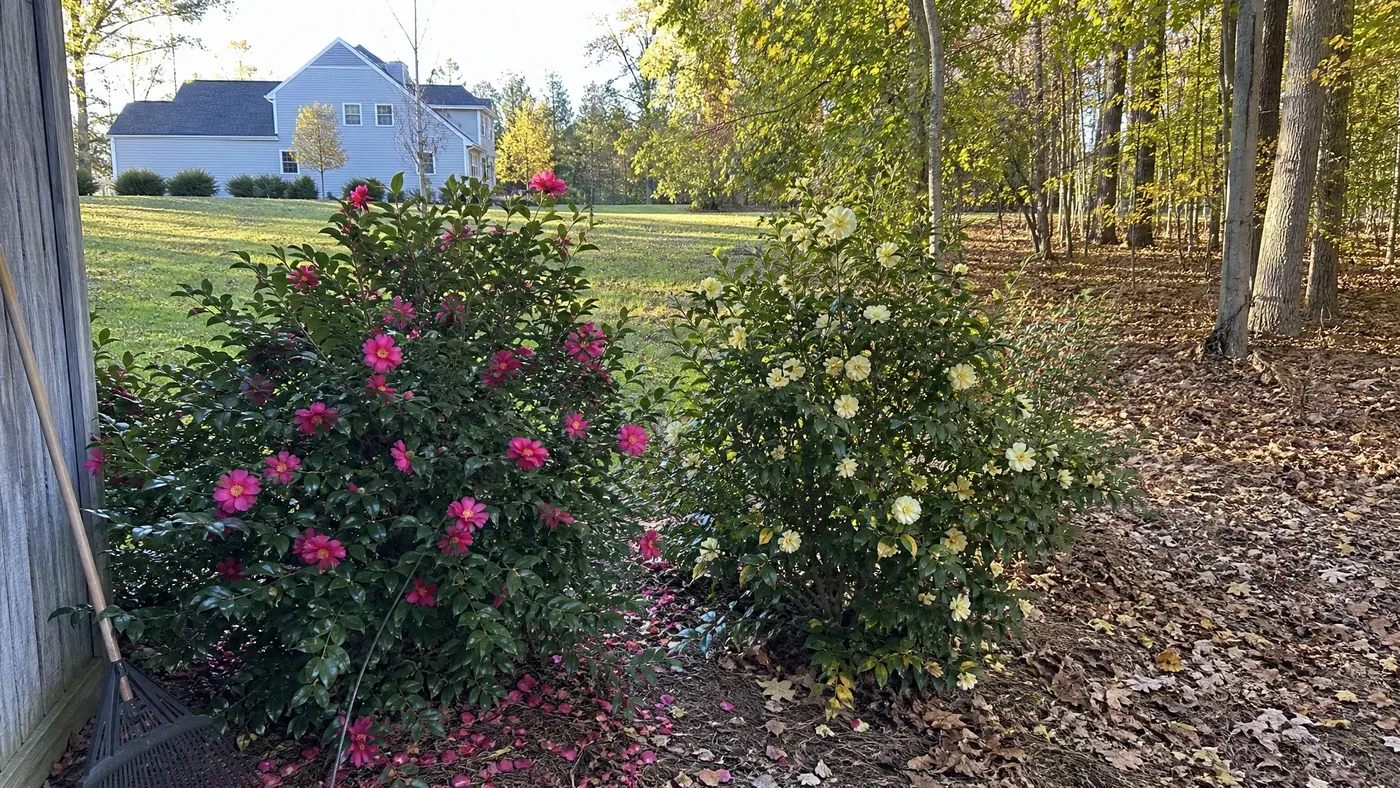
Stephanie Golden Camellia vs Autumn Moon Camellia: Color and Size
You are standing at a nursery bench holding two plant tags. One color swatch is a hot pink, the other a pale ivory-yellow, close to old piano keys, and then you notice that both tags say sasanqua. A customer once asked us, in nearly these words, "If one is called Golden, why is the other one the yellow camellia?"
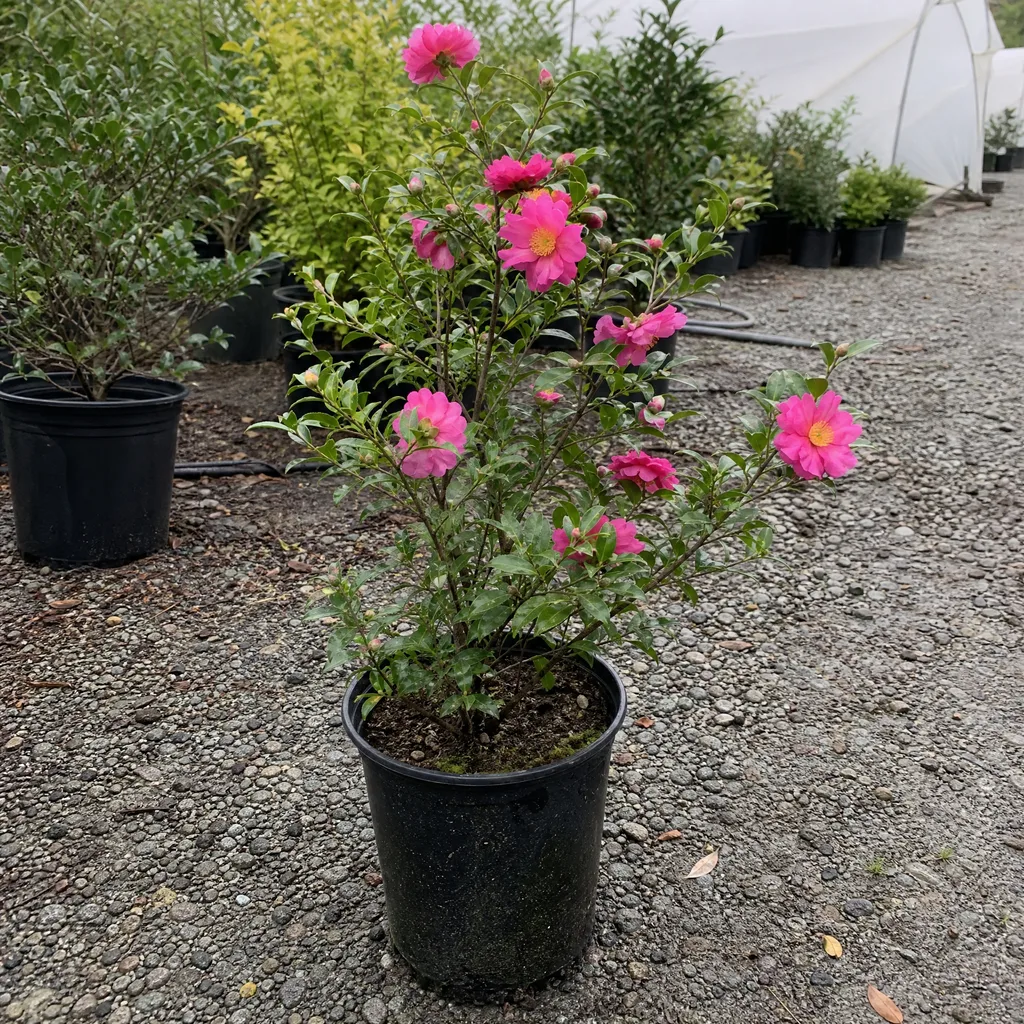
The answer surprises most people. Stephanie Golden blooms hot pink, and the gold is only in the stamens at the center of each flower. Autumn Moon is the genuinely pale one.
This guide covers everything you need to know about choosing between them, from bloom color and flower form to mature size, hardiness and soil. Choosing wrong leaves you with a shrub that fights its bed for years, so it is worth settling before you dig.
What Bloom Color Means on a Sasanqua
Three terms do most of the work in a camellia comparison, so it helps to define them first. Bloom color is the color of the petals, which across the sasanqua species runs from white to deep red depending on the cultivar. Petal form describes how many petals a flower has and how they are arranged. Stamens are the pollen-bearing center of the flower, made of thin stalks called filaments and the tips on top of them, called anthers.
Sasanqua flowers are mostly single or semi-double and, as Clemson's extension notes, run 2 to 3 inches across and very fragrant. That size is the same for both plants, so the comparison comes down to color and form rather than flower size.
The word "Golden" causes the confusion. Extension descriptions of the species speak of flowers from white to pink, with no yellow petals at all. Stephanie Golden earns its name from yellow anthers and filaments against hot pink petals. Autumn Moon sits at the other end, with a pale ivory-yellow that often photographs and reads as white.
Color is also a question of distance. A saturated pink is visible from the street, from a kitchen window and across a lawn. A pale bloom needs you within a few steps to register as anything but a light patch. Our verdict: for color that carries at a distance, Stephanie Golden wins clearly.
Stephanie Golden Camellia Flower Form and Stamens
Stephanie Golden is a hot pink, semidouble flower with yellow anthers and filaments. Semidouble means the flower has more than one row of petals, but not so many that the center is packed. Gardeners often describe a double as a rosette and a single as a flat, open cup. A semidouble sits between the two, and that is why the yellow center is still visible.
The University of Florida lists single, semi-double and double forms for sasanquas, so Stephanie Golden is typical of the species in form and unusual in color intensity. The stamens do real design work. Yellow against hot pink gives each flower a bright eye, and from a few feet away the whole shrub looks lit from inside.
A fully double camellia hides its stamens under layers of petals and drops its flowers whole. A semidouble shows them, which also means the flower reads more open and informal. If you want a tidy, formal bloom like a rosebud, this is not that, and we would rather tell you now.
One plant opens its flowers over four to six weeks, so the show unfolds gradually rather than all at once. For timing detail, see our guide on when Stephanie Golden Camellia blooms. Our verdict: for form, Stephanie Golden is the more interesting flower, because the stamens give it a second color.
Autumn Moon Camellia and Its Ivory Petals
Autumn Moon is the opposite design: a pale ivory-yellow flower that borders on white. Pale blooms behave differently from saturated ones. They hold their own against dark glossy leaves, because the contrast between light petals and deep green is strong at close range. But they lose strength in bright midday sun, when light washes them out, and they can disappear against a white fence or pale stucco wall.
Light changes the color too. In low autumn light and in shade, an ivory flower takes on a warm cream or faint yellow cast. Under a hard noon sun the same flower can look nearly white. The swatch at the nursery bench is only a first guess. Look at the plant in the light of the spot where it will actually grow.
In our rows, customers who bring home a pale sasanqua are usually surprised by how much they notice it at dusk, when pink flowers have already faded into the greens and the ivory ones still show.
That is the real strength of Autumn Moon. It suits a shaded corner, a path you walk in the evening, or a bed next to a dark wall. We do not have a verified source for its flower form, so check the tag for whether it is single or semidouble before you count on a stamen display.
Our verdict: on visibility, Autumn Moon wins up close and in shade, while Stephanie Golden wins everywhere else.
Reading Height and Width Numbers for Stephanie Golden Camellia
A height range on an extension page works like a clothing size label. It tells you the family your plant belongs to, not exactly how it will fit your yard. For Camellia sasanqua, NC State lists 6 to 14 feet tall and 5 to 7 feet wide. Oregon State gives a tighter 6 to 10 feet, and the University of Florida notes that sasanquas overall span 4 to 15 feet. Those are species figures, and the spread between them is the point: cultivars vary.
So read each range in two steps. First, take the low end as what you can expect in a few years with some pruning, and the high end as what an unpruned plant in good soil may reach. Second, ask whether a number describes the species or the cultivar. Stephanie Golden is a cultivar, and we have no cultivar-specific height, so treat the species range as your planning frame. Our guide on how big Stephanie Golden Camellia really gets goes further.
For Autumn Moon, we do not have a figure we can stand behind, and we will not guess. Read the tag at purchase, then check with your local extension service for a number from your region.
Two facts help with either plant. Clemson's extension says sasanqua cultivars grow faster than japonicas, so size arrives sooner than you might expect. And extension specialists advise pruning immediately after flowering to shape sasanquas, which keeps size in your hands.
Our verdict: plan on the larger number, because a shrub that stays smaller costs you nothing and one that outgrows its spot costs you a replanting.
Which Shrub Fills a Space Better?
Now apply those numbers to a real space. Measure the width of the spot first, because width is the number people forget. At the species figure of 5 to 7 feet wide, a Stephanie Golden planted in a 4-foot gap will press against whatever sits beside it within a few seasons. Height matters less in beds and more under windows and eaves.
Here is how we would match each plant to the three situations customers describe most often:
- A bed in front of a house wall. Stephanie Golden gives you a bold focal plant. Pull it forward from the wall by at least half its mature width so air can move behind it.
- A screen or hedge. Either shrub works if you plant it in a line, but the stronger pink makes a more dramatic wall in fall. See spacing Stephanie Golden Camellia for hedges and borders before you set the plants.
- A shaded corner. Autumn Moon's pale flowers brighten dim spots where a deep pink might sink into the shadow, so it is the better fit there.
Sun changes the picture too. Sasanquas tolerate more sun than japonicas, and Stephanie Golden is a sasanqua, so it can handle a sunnier bed. Pale flowers fare better in light shade, which protects the petal color from washing out. For more on exposure, our guide to sun and shade needs for Stephanie Golden Camellia covers it.
Our verdict: for open beds and screens, Stephanie Golden fills the space better. For tight, shaded corners, choose Autumn Moon.
Hardiness and Soil for Stephanie Golden Camellia
Both plants are sasanquas, so cold tolerance and soil needs overlap closely. The species is hardy in USDA zones 7a through 9b, so we plan around that range for Stephanie Golden. For Autumn Moon, we have no zone source, so confirm it on the tag or with your extension office.
Sasanquas have a timing advantage here. They flower in late fall and are less likely to suffer from early freezes than japonicas, which bloom in winter. That protects the buds you have waited all year for.
Defining Acidic, Well-Drained Soil
Oregon State says the species prefers moist, well-drained, acidic soils high in organic matter. "Acidic" means a soil pH below 7, and camellias do best around pH 5.5 to 6.5. "Well-drained" means water soaks in and moves through rather than pooling. These two conditions sound opposite to "moist," but moist and soggy are different things.
Reading the Warning Signs
If something goes wrong, the leaves tell you what. Here is how we read them over the phone:
- Leaves turning yellow between the veins usually point to soil that is not acidic enough, and a soil test will confirm it.
- Wilting leaves in soil that feels wet point to poor drainage. Root rot caused by Phytophthora is favored by standing water and long wet periods.
- Leaves that crisp and brown at the edges in summer often mean dry roots or too much afternoon sun.
Common advice says all camellias belong in deep shade. For sasanquas that overstates it, since they tolerate more sun than most camellias. Our guide to soil and drainage for Stephanie Golden Camellia covers amending a poor site. Our verdict: a tie, since both plants want the same soil and the same climate.
Choosing Between Stephanie Golden Camellia and Autumn Moon
With color, form, size and soil sorted, the choice comes down to what you want from the bed in fall. The table below gathers each verdict in one place, so you can see where the two plants part ways and where they do not.
| Question | Our pick |
|---|---|
| Color that shows from across the yard | Stephanie Golden |
| A soft flower for shade or evening light | Autumn Moon |
| A visible yellow stamen display | Stephanie Golden |
| An open bed or a screen | Stephanie Golden |
| Soil and cold hardiness | Equal, same needs |
If you want one shrub, we would choose Stephanie Golden for most people. It has a documented form, a bold color that survives distance and a size range we can plan around. We would choose Autumn Moon for a shaded corner, a pale color scheme, or a gardener who finds hot pink too loud.
Because their needs match, they also share a bed well. Plant them a full mature width apart, with the pink toward the open side and the pale one in the shade, and you get a gradient of color through the same weeks of fall. For more pairing ideas, see similar sasanqua cultivars to Stephanie Golden Camellia.
Settling Your Stephanie Golden Camellia Purchase in October
Try one simple test. Picture the bed in October, with the light low and the leaves still dark green. Decide whether you want a bold color or a soft color standing there, and let that choice settle the purchase. If the picture is hot pink with a yellow center, you want Stephanie Golden. If it is a pale glow among the leaves, you want Autumn Moon.
Whichever you pick, the work after planting is the same: acidic, well-drained soil, even moisture, and pruning right after the flowers finish. Get those right and either shrub will repay you every fall.
Stephanie Golden Camellia
Nursery-grown Stephanie Golden Camellia in sizes from 2.5 Quart, shipped to your door.
From $37.93
Shop Now →We grow Stephanie Golden on our own farms in the acidic, well-drained soil it prefers. Its hot pink blooms are the bold fall color that Autumn Moon's pale flowers are not. We are a small business that grows its own top-quality shrubs, so browse our shop when you have made your pick.