Stephanie Golden Camellia vs Stephanie Gold Camellia
You open a listing and the tag reads 'Stephanie Gold'. You searched for Stephanie Golden, the hot pink sasanqua with yellow stamens, so the doubt arrives fast. Is this a different camellia, or the same one with a syllable missing?
We think it is the same plant, and the evidence for that is far better than the evidence for any separate "Gold." The doubt is still reasonable, because sasanquas come in many cultivars and a wrong one can mean a different flower color or a different mature size.
In this article, we'll go through where the clipped name came from, what the registered record says, how the claims for a separate plant hold up, and the tag checks that settle it before you pay.
Where the Shortened Name Came From
Start with what we cannot do. We cannot point to the first catalog or nursery list that printed 'Stephanie Gold', and we distrust anyone who offers a tidy origin story with a date attached. What we can say is that the shortened name appears on at least one major retailer's listing for this plant.
What the Trail Actually Shows
A name repeated on a big listing spreads quickly, and the spread is mostly mechanical. A shopper searches the registered name, lands on the clipped listing, and repeats what they saw in a forum post, a garden-center sign or a wish list. Each copy looks like independent confirmation that a second name exists, when it is really one listing echoing itself.
Count sources the way a skeptic would. Ten pages that all say 'Stephanie Gold' are worth one page if they trace back to the same supplier feed. Count the independent origins, not the number of pages.
Why the Clip Feels Natural
The flowers are hot pink, so "Golden" is not an obvious description of the plant, and "Gold" reads as a cleaner, more familiar word for a tag. That is our guess about why the shortening sticks, not a documented cause. It also sounds like a color, which quietly invites the wrong picture of the bloom.
So treat the clipped name as a labeling habit rather than a lineage. The useful question is never which spelling came first. It is whether the plant behind the label matches the registered cultivar, and the record lets you test that.
Stephanie Golden Camellia in the Registry Record
The registered cultivar name is 'Stephanie Golden', and the plant belongs to Camellia sasanqua. That pairing of name and species is the anchor for everything else in this guide. We will not invent a registration year or a breeder for it, and if a seller quotes either one, ask where it came from.
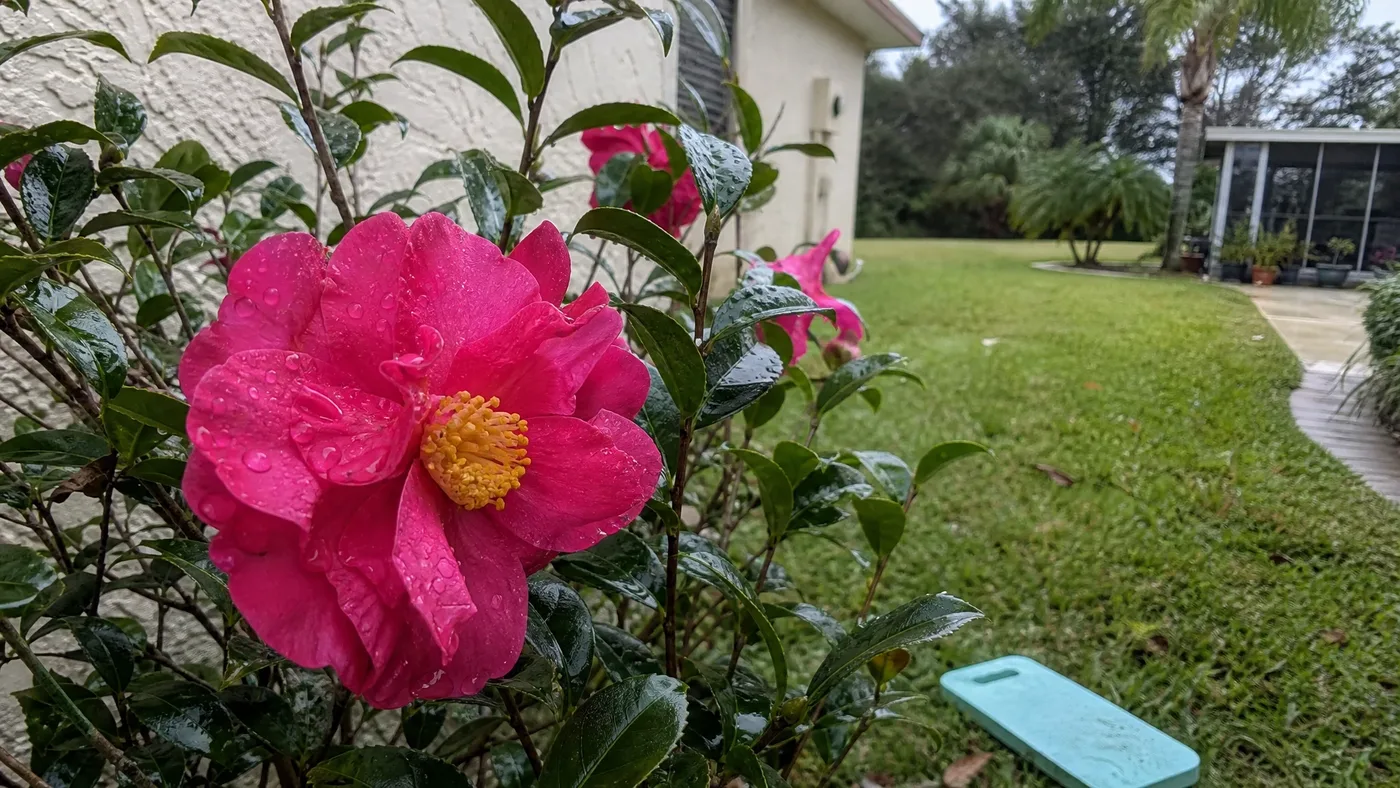
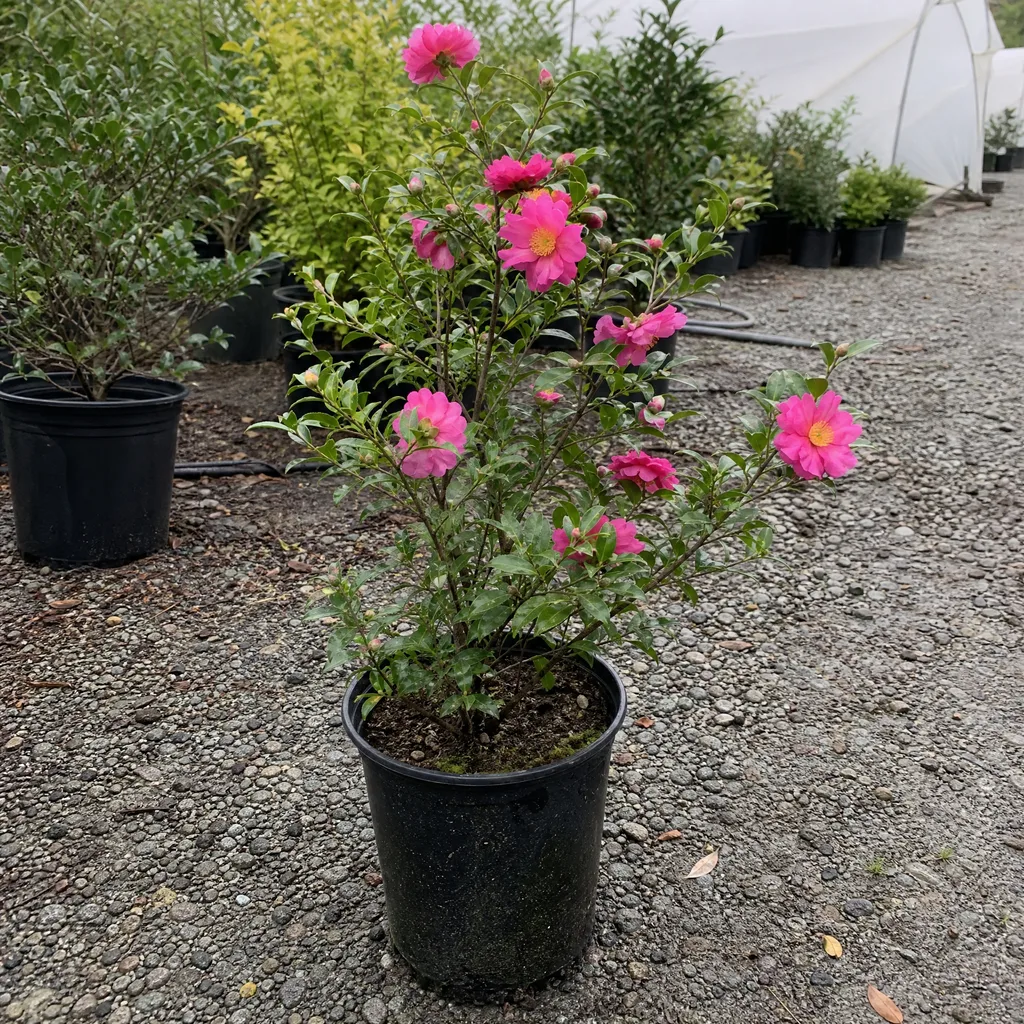
The record describes the flower as hot pink with bright yellow stamens, semidouble in form. That is narrower than the species, which runs from white to deep red depending on cultivar. A plant sold under either spelling that opens white or red is not this one.
Bloom Season as an Identity Check
Sasanquas bloom earliest among camellias, October through December according to UF/IFAS, while japonica types follow from December into March. Our bloom timing guide covers the calendar in detail.
For identity purposes the point is simple. A camellia in full flower in late winter or spring is behaving like a japonica, not like this cultivar. The foliage helps too, since sasanquas carry glossy, dark green leaves year-round.
What the Record Leaves Out
One gap deserves honesty. The registry does not list a hardiness range for the cultivar itself, so any zone figure attached to it is borrowed from the species. We come back to that when we test the claims below.
The same caution applies to size. Species figures are a fair guide, but nobody should treat them as a measurement of this exact plant.
Why Retailers Drop a Syllable
We cannot see inside any retailer's catalog system, so what follows are habits we recognize from the trade, not proven causes. They are enough to explain a one-syllable loss without needing a second plant. None of them requires anyone to have done anything wrong.
How Listings Get Trimmed
Most trimming comes from the way product data moves between systems. These are the patterns we think explain it:
- Listing titles often have a character limit, and a long cultivar name plus "Camellia sasanqua" plus a pot size gets trimmed from the end or the middle.
- Product data is frequently typed into a spreadsheet once and then copied across every channel, so a single shortened entry becomes dozens of identical ones.
- Staff who see "Golden" as a color word sometimes shorten it to a form that looks more like a standard plant tag.
- Suppliers feed the same plant to many sellers, and each seller edits the name a little to fit its own style.
What a Clipped Name Does Not Mean
One of the most common questions we get is whether the clipped listing means a cheaper or lesser plant. It does not, and nothing in the record suggests it. A shortened title tells you about the seller's data entry, not about the plant's genetics.
The useful reading is that a trimmed name is a signal to check the rest of the listing, not a reason to walk away. If the botanical name, flower color and bloom season all match, the missing syllable is cosmetic.
Do Any Claims of a Separate Plant Hold Up?
We have heard three versions of the claim that 'Stephanie Gold' is its own selection. We tested each against what the record and the sources actually say. None of them survived, and the reasons differ enough to take one at a time.
The Yellow Flower Claim
The name invites the idea that "Gold" means a yellow or golden bloom. It does not. The registered flower is hot pink, and the yellow belongs to the stamens in the center.
A camellia that opens truly yellow would be a different plant, and neither spelling describes one. If a photo on a listing shows a pale or yellow flower, the photo is wrong or the plant is.
The Hardier or Smaller Claim
Some listings imply an improved form that is tougher or more compact. The registry lists no hardiness figure for this cultivar, so there is nothing to improve on in the record. A claim to beat a number that does not exist cannot be checked.
Size works the same way. The species spans a wide range, and the numerous cultivars including dwarf forms are exactly why you should confirm the exact name rather than trust a vague "compact" label.
The New Selection Claim
A genuinely new cultivar would need its own registered name, and we know of no registration for a 'Stephanie Gold' separate from 'Stephanie Golden'. Where a listing offers one, ask the seller for the record. If they cannot supply it, the simpler explanation wins.
Real look-alikes do exist, and our guide to similar sasanqua cultivars covers them. Those are distinct names with distinct flowers, which is the opposite of a clipped spelling.
Reading Plant Tags for Stephanie Golden Camellia
You do not need a registry login to protect yourself. A few checks on the tag or listing will separate a clipped name from a real mix-up, and they take only a few minutes. Do them before you pay, because a camellia that blooms the wrong color will not reveal itself until fall.
Four Checks Before You Order
Run through these in order, and stop if any one fails:
- Look for the botanical name, Camellia sasanqua, next to the cultivar. A common name alone is not enough.
- Read the flower description. Hot pink, semidouble, with yellow stamens fits. White, red or double-formed does not.
- Check the bloom season. Fall into early winter fits a sasanqua. Late winter and spring flowering points to a japonica type.
- Ask the seller whether the plant is identified as Stephanie Golden in their records. Sellers who know their stock will answer in one line.
Common Listings and What to Do
The table below shows how to read the situations you are most likely to meet.
| What the listing says | What it usually means | What to do |
|---|---|---|
| Stephanie Gold, with Camellia sasanqua and hot pink flowers | Shortened title, same plant | Buy, and note the full name for your records |
| Stephanie Golden, no botanical name | Incomplete data | Ask which species it is before you order |
| Stephanie Gold, white or red flowers pictured | Wrong photo or wrong plant | Ask for the actual plant photo or move on |
| Only "Camellia sasanqua," no cultivar | Unidentified cultivar | Do not assume it is this one |
After the Plant Arrives
We often see tags that carry only the species with no cultivar at all, and that is a bigger risk than a missing syllable. Keep whatever label came with the plant, and photograph it next to the first open flower.
If the bloom is hot pink with yellow stamens in fall, you have your answer. If you want help matching size to your space before you decide, our buying guide walks through it.
What Stephanie Golden Camellia Needs Either Way
Because it is one plant, the growing needs do not change with the spelling on the tag. We will not repeat the full routine here, since our care guide covers it. A few points are worth stating for anyone who bought on the strength of this guide.
Soil and Yellow Leaves
Sasanquas like acidic soil and even moisture in summer, per Arkansas extension, with good drainage and plenty of organic matter. UF/IFAS puts the pH range for camellias at 5.0 to 6.5, and we aim for the middle of that.
When leaves turn pale or yellow, we check soil pH and drainage before anything else. Poor drainage also favors the root disease that University of California IPM describes, so a soggy bed can look like a nutrient problem when it is really a water problem.
Light and Climate
The species tolerates more sun than most camellias but does best protected from harsh afternoon sun. For climate, the species is hardy in zones 7 to 9. Because the registry gives no separate figure for the cultivar, we treat that as the working range.
Our zones guide goes further, and your local extension service can tell you how a marginal site behaves in your area.
Size to Plan For
North Carolina State extension lists the species at 6 to 14 feet tall and 5 to 7 feet wide, which is a wide window. Plan the space for the upper end until you know how your plant behaves.
That is another reason the exact cultivar name matters. Dwarf sasanquas stay far smaller, and a mislabeled plant can crowd a path in a few years.
Stephanie Golden Camellia, One Plant Under Two Names
Both names point to one plant: the registered cultivar Camellia sasanqua 'Stephanie Golden', with hot pink semidouble flowers and yellow stamens. 'Stephanie Gold' is a trimmed label, and none of the claims for a separate or improved version holds up against the record. Trust the registered name, and treat the shortened one as a prompt to check the rest of the listing.
The evidence supports one cultivar under two spellings, and what a buyer can verify with the seller is the botanical name, the flower description and the bloom season on the plant they are actually buying.
Stephanie Golden Camellia
Nursery-grown Stephanie Golden Camellia in sizes from 2.5 Quart, shipped to your door.
From $37.93
Shop Now →Anyone who wants the right Stephanie Golden should know how ours are raised: in well-drained, acidic soil rich in organic matter, with a bit of shade from the hottest afternoon sun. Our own growers raise and pack every top-quality camellia, so the name on the tag is the plant in the box. When you are ready, pick out a Stephanie Golden for your own garden.